
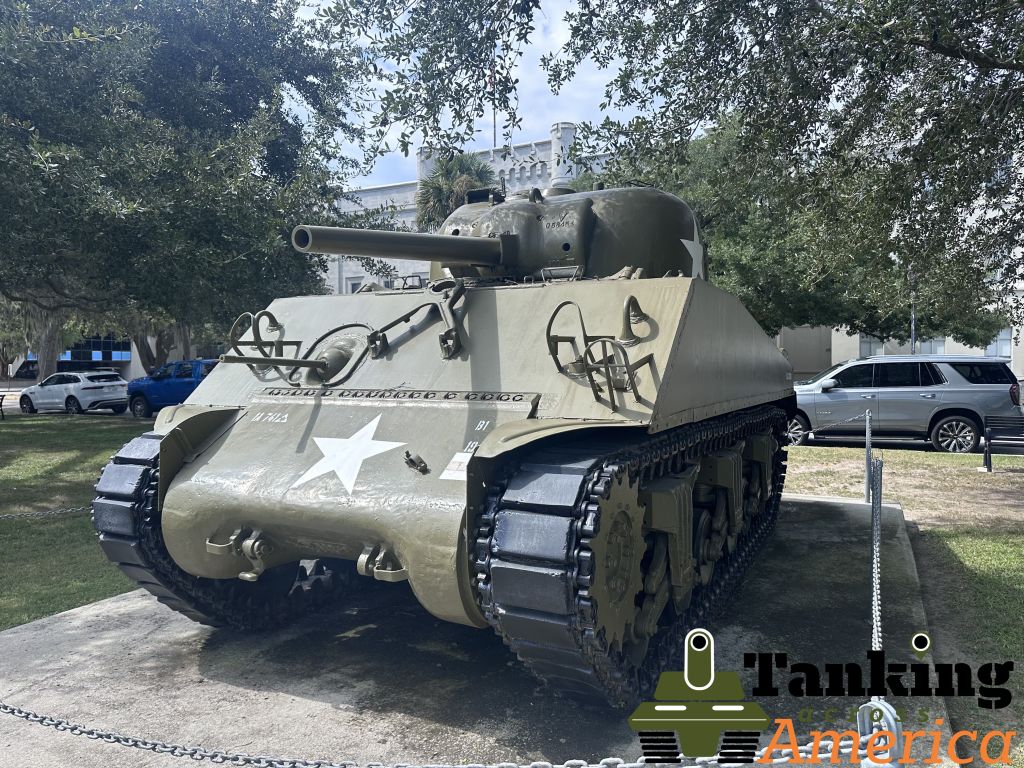
Standing near the northwest corner of Summerall Field in Charleston, South Carolina, is one of The Citadel’s most recognizable military displays: an M4 Sherman tank. For generations of cadets, alumni and visitors, the tank has served as a physical link between the historic military college and the Americans who fought in armored units during the Second World War.
Although it has long been known by the name “Thunderbolt,” the Sherman’s modern markings commemorate a Citadel graduate whose wartime service began amid the chaos of Omaha Beach.
A Sherman Comes to The Citadel
The Sherman was presented to The Citadel in 1956 and placed on its campus as the school’s Army memorial. It eventually became a familiar landmark on Summerall Field, the twelve-acre parade ground at the center of cadet life.
The Citadel’s campus history identifies the vehicle as an M4A4 Sherman, while a 2023 account of its restoration describes it as an M4A1/3. Surviving Shermans displayed outdoors were sometimes rebuilt with parts from different vehicles, so positively identifying a particular example may require careful examination of its hull, engine deck, suspension components and serial markings.
Whatever its precise production designation, the vehicle represents the Sherman family that formed the backbone of American and Allied armored forces during World War II.
The “Thunderbolt” Connection
For many years, The Citadel associated its Sherman with Lieutenant Colonel Creighton W. Abrams and the famous tanks he commanded in Europe. Abrams led the 37th Tank Battalion of the 4th Armored Division during General George S. Patton’s drive across France and into Germany.
Abrams named a succession of his command tanks Thunderbolt, with a Roman numeral added as each vehicle was replaced. His aggressive leadership—and his ability to use the Sherman’s mobility, radios and teamwork to overcome German resistance—made him one of the best-known American armor commanders of the war.
The Citadel’s tank was not one of Abrams’s actual wartime vehicles, but the name connected the campus display with the traditions of American armored warfare.
The tank also acquired a more mischievous chapter in Citadel history. According to the college, cadets once managed to put gasoline in it and drive it off campus before becoming stranded. Its engine was subsequently rendered inoperable, preventing a repeat performance.
Captain John Thornton and Omaha Beach
During the restoration of The Citadel’s outdoor military displays in 2023, the Sherman received markings honoring Captain John Thornton, Citadel Class of 1940.
Thornton served as an armor officer and commanded Company B of the 741st Tank Battalion. For the Normandy invasion, Companies B and C of the battalion were equipped with Duplex Drive Shermans. These unusual amphibious tanks carried collapsible canvas flotation screens and propellers that theoretically allowed them to “swim” from landing craft to shore.
On June 6, 1944, the 741st Tank Battalion was assigned to support the 1st Infantry Division’s assault on Omaha Beach. The sea was far rougher than expected, yet most of the unit’s DD tanks were launched thousands of yards offshore. Of the 32 amphibious Shermans assigned to the assault, 27 were lost before reaching the beach.
Thornton’s tank was among those that sank. He survived the disaster and reached shore, although he was wounded during the invasion. Despite the loss of his vehicle and the terrible conditions on Omaha Beach, he remained in command of his company as the battalion fought its way inland.
From Normandy into France
After D-Day, the 741st Tank Battalion received replacement Shermans and continued supporting American infantry formations across northern France.
Independent tank battalions such as the 741st were frequently attached to infantry divisions. Their Shermans provided direct fire against fortified positions, transported supplies across exposed ground and helped infantry units overcome enemy strongpoints. This cooperation was difficult and dangerous. Tank crews often fought at close range in hedgerows, villages and narrow roads where German antitank guns could remain concealed until the last moment.
Captain Thornton continued leading Company B through this demanding campaign. In September 1944, his Sherman was struck by at least three antitank rounds while he was leading his men. Thornton was killed in the action.
His death came only a few months after surviving the sinking of his amphibious tank off Omaha Beach.
Restored as a Memorial
Charleston’s sun, humidity and salt-laden air had taken their toll on The Citadel’s outdoor exhibits. As part of a restoration program, the Sherman was cleaned, repaired and repainted.
Rather than attempt to present the vehicle as Thornton’s original tank, The Citadel marked it as a memorial representation of his Sherman and his service. The painted registration number incorporates 1940, recognizing Thornton’s graduating class and strengthening the connection between the vehicle and the man it honors.
That distinction is important. The Sherman on Summerall Field is not claimed to be the tank Thornton commanded in combat. It is a surviving example used to tell his story.
More Than a Display Tank
The M4 Sherman is sometimes judged only by its armor thickness or the power of its gun. Its real importance, however, came from the complete system surrounding it. American factories built Shermans in enormous numbers, while an extensive supply and maintenance network kept them moving. Their mechanical reliability and standardized design allowed damaged tanks to be repaired or replaced relatively quickly.
For the crew, none of that made combat safe. Sherman tankers lived and fought inside a cramped steel compartment filled with ammunition, fuel, heat, noise and fumes. They faced mines, artillery, concealed antitank guns and heavily armored German vehicles. Every mission required courage and close cooperation among the commander, gunner, loader, driver and assistant driver.
The Citadel’s Sherman therefore represents more than a famous type of armored vehicle. It recalls the people who operated such machines under the most difficult circumstances imaginable.
A Lasting Presence on Summerall Field
Today, the Sherman stands among several historic military exhibits at The Citadel, including an AH-1 Cobra attack helicopter, an F-4C Phantom II and an LVTH-6 amphibious fire-support vehicle. Together, these displays connect different generations of American military service.
The Sherman has carried several layers of meaning during its decades on campus. As Thunderbolt, it recalled the aggressive armored leadership of Creighton Abrams. Following its restoration, its markings now tell the deeply personal story of Captain John Thornton—a Citadel graduate who survived the disastrous launch of his DD tank on D-Day, continued leading his company across France and ultimately lost his life in combat.
It is an appropriate memorial for a school whose history is closely connected with military service. Quietly overlooking Summerall Field, the old Sherman reminds each passing generation that history is not merely a collection of vehicles, battles and dates. It is the story of people—and of the sacrifices they made.
Sources: The Citadel’s restoration history and Summerall Field visitor information.

